Rejuran and Re2O both work in the dermis, but they approach it from opposite directions. Rejuran delivers polynucleotides (PN) derived from salmon, prompting the skin to rebuild its own collagen. Re2O places extracellular matrix (ECM) — taken from donated human dermal tissue with the cells removed — directly into the dermis. Ask the skin to make it, or hand it over ready-made: that difference is the whole decision.
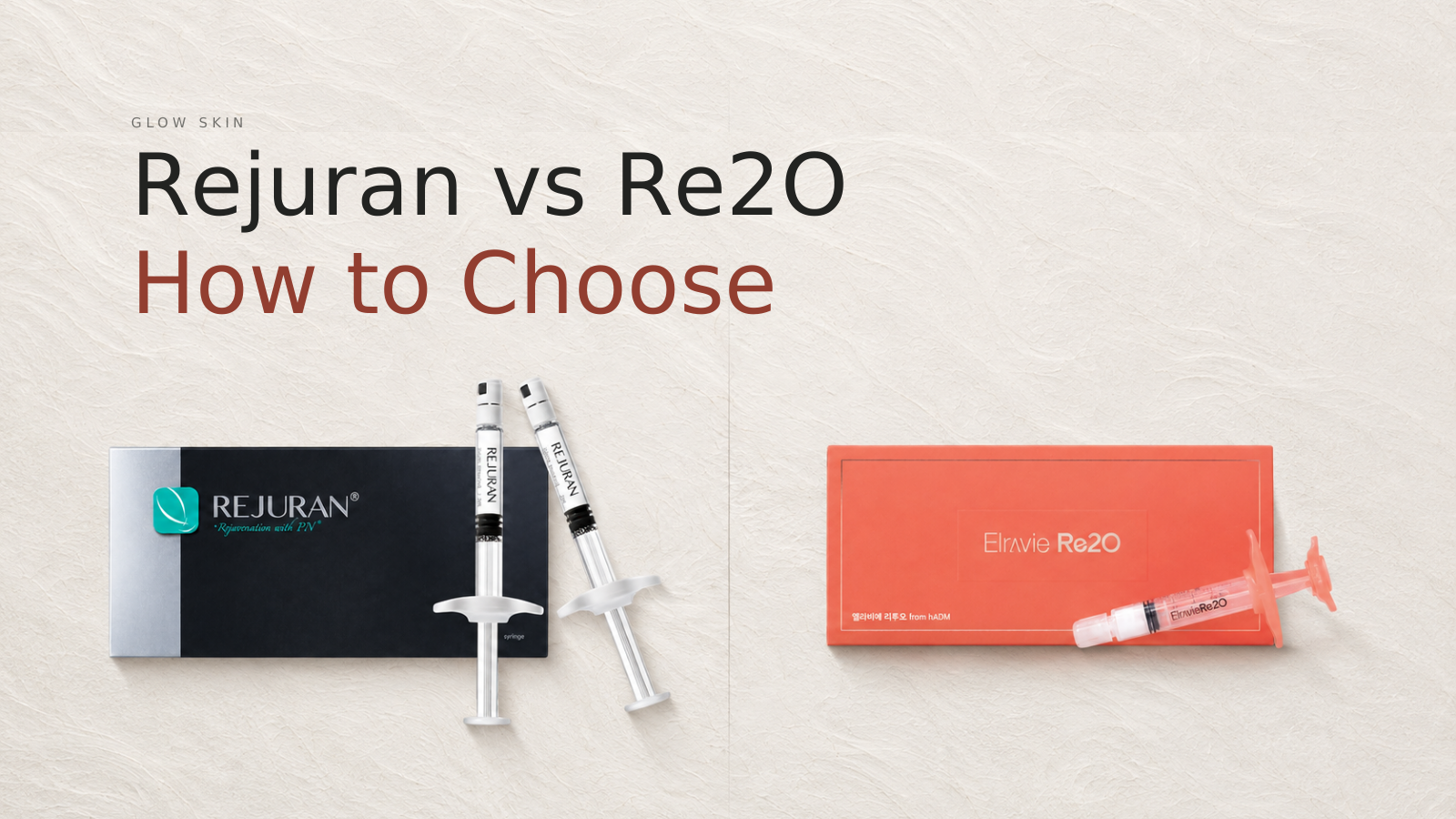
In consultation, Rejuran and Re2O come up in the same breath almost every time. Both are injected across the face in small amounts, both are described as improving skin texture, and both take a similar amount of time with a similar recovery.
So the question arrives: which one is better? But what separates them isn't performance. It's where the material comes from.
Something needs establishing first. What thins with age is not collagen alone.
The dermis is a mesh — collagen, elastin, hyaluronic acid and other components woven into a single structure. That whole structure is called the extracellular matrix, or ECM. Collagen is one thread in it.
Aging is less a matter of collagen running low and more a matter of the whole mesh growing loose. Holding that picture in mind is what makes the difference between these two treatments legible.
Rejuran Healer delivers polynucleotides extracted from salmon into the dermis. PN is not a material that fills the mesh on the skin's behalf. It works closer to setting up the conditions for the skin to weave the mesh again itself.
Which means the change takes time to arrive. The skin has to begin working first. What arrives, though, is a change in the skin's own condition — the kind read through texture and resilience, through fingertips and expression rather than a mirror alone.
It comes up when the concern is the skin's capacity to recover: texture that has roughened, a sense of thinness, skin that reacts more easily than it used to. PN boosters have a long clinical track record in Korea and remain the most widely known booster category here.
Re2O reverses the approach. Rather than asking the skin to weave, it brings a mesh that is already woven.
That mesh comes from donated human skin tissue. Once cells and the elements capable of provoking an immune response are removed, what remains is the ECM structure — a material called hADM, human acellular dermal matrix. Refined into fine particles, it is placed into the dermis. According to the manufacturer, collagen makes up most of it, alongside elastin and other structural components.
Because no waiting stage is involved, a change in density tends to register comparatively early. This is a different kind of change from the dewy, light-catching finish of hydration-led treatments. What shifts is not the surface but the density underneath it.
It comes up when the density of the dermis is what catches your eye first: skin that has thinned, that reads as loose or sparse, pores and fine lines that have become more visible.
There is one point we always explain when discussing Re2O: the material originates from donated human tissue.
In Korea, acellular dermal matrix has long been used in reconstructive care for burn patients, and it falls under the Human Tissue Safety and Management Act rather than general device regulation. The processing removes cells, genetic material and immune antigens, leaving only the structural components.
And this is precisely what gives the category its character. Some collagen-building treatments work by way of the body responding to an unfamiliar substance — the response is the mechanism. Re2O does not take that route. Because what is placed is the same kind of material the skin is already made of, the body is not being asked to recognize anything foreign. This is why the category is generally understood to carry a lower likelihood of foreign-body reaction.
Even so, we think it is better that you know this beforehand. A treatment should be chosen after the principle is understood, not before. Ask us anything about it in consultation.
| Rejuran Healer | Re2O | |
|---|---|---|
| Material | Polynucleotides from salmon | ECM from donated human tissue (hADM) |
| Approach | Signals the skin to build | Places what is already built |
| When change registers | Gradually | Comparatively early |
| Mainly addresses | Recovery capacity, texture, sensitivity | Dermal density, substance |
| The body's response | Works through the skin's own repair process | Does not rely on a foreign-body pathway |
| Category | PN booster | ECM booster |
Neither column sits above the other. A newer category is not therefore better, and an established one is not therefore behind. The question worth asking is: does my skin need a signal, or does it need material?
If, in the mirror, your skin looks reactive and tired, the issue is more likely one of recovery. If it looks thin and sparse, the issue is more likely one of density. That distinction is where most consultations begin.
Skin rarely presents one problem at a time. Thinning alongside increased sensitivity is the most common picture of all.
The two treatments differ in material and in mechanism, so they don't work against each other. A common design has one raising the density of the foundation while the other builds the skin's capacity to recover above it. Using them together isn't an unusual combination — it's an ordinary one.
Re2O belongs to a wider category that has grown quickly in Korea over the past two years. We look at it in more detail in our piece on ECM boosters.
A doctor looks at the thickness and condition of your skin, the direction it has changed in recently, and what treatments you have had before. Skin that turned sensitive over a few months and skin that has been thinning for years are not approached the same way.
At DayBeau Gangnam, we settle on the treatment and its structure after that assessment. Because responses and duration differ from person to person, the decision follows the diagnosis rather than preceding it.
These two treatments are not competing. One asks the skin to build; the other hands it what has already been built. Which one you need right now is the answer.
Written by the DayBeau Gangnam Medical Team · Medically reviewed by the DayBeau Gangnam Medical Team
The answer starts with what your skin is missing right now.
Book a consultation→