The question we hear most often in a lifting consultation is which treatment is the best one. It is a fair question, and a hard one to answer well — because these treatments are not arranged from better to worse. Each one reaches a different layer of the face.
So this article does not rank them. It describes how four kinds of energy travel into the skin, and where each one comes to rest. Once that structure is clear, the reasoning behind a doctor's recommendation becomes much easier to follow.
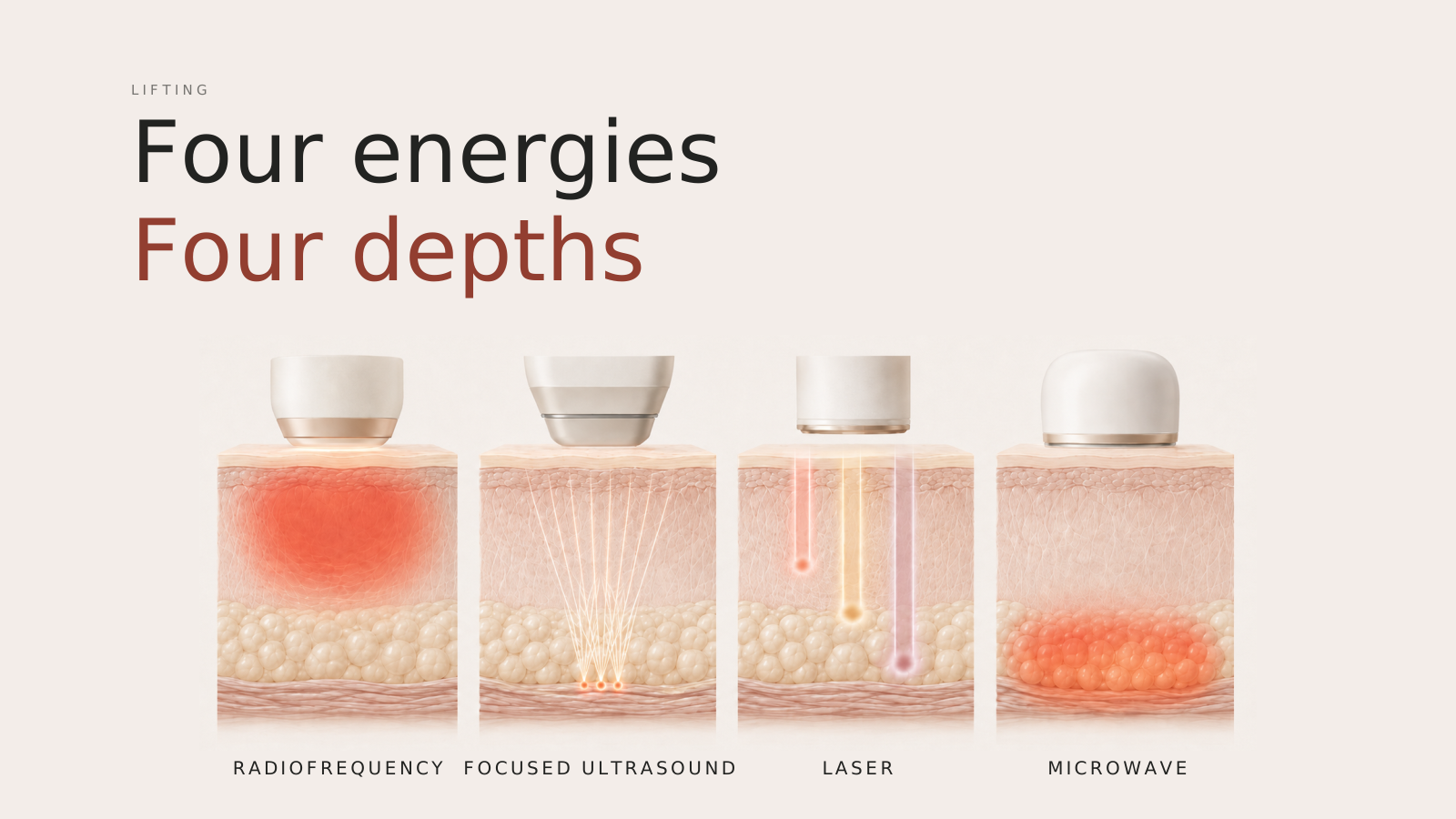
What a lifting device does can be put in a single sentence: it delivers controlled energy to a chosen depth, and the body responds.
When that energy reaches the tissue, collagen fibers tighten, and over the following weeks the body begins a remodeling process of its own. The device is not pulling the face upward. It is sending a signal, and the skin does the work. This is why the change from a lifting treatment tends to arrive gradually rather than on the day itself.
The four energies below send that same signal — but they travel differently, and they stop in different places.
Ultrasound lifting focuses sound waves through a lens so that they converge on a single point inside the tissue. The energy passes through the surface without settling there and comes together only at the depth the doctor has selected. It is, quite literally, a way of choosing a depth.
Two ultrasound treatments can therefore behave quite differently. Ultherapy Prime travels to the deep fascial layer — the supportive tissue beneath the fat that holds the shape of the face — and delivers its signal there. Sofwave sends several beams side by side into the mid-dermis, working across a broader area closer to the surface.
One goes deep. One goes wide. That is why they are not competing for the same ground.
Radiofrequency passes a current through the skin, and the tissue's own resistance turns that current into heat. Nothing is focused to a point. Instead, the epidermis and dermis warm together as a volume.
Thermage FLX works this way. Heat delivered into the dermis engages the collagen fibers there, and the body's remodeling response follows. The effect is less about drawing a particular line upward and more about how firm and dense the skin itself feels. Working across a surface rather than at a point is the fundamental difference between radiofrequency and ultrasound.
Light is absorbed at different depths depending on its wavelength. Shorter wavelengths give up their energy near the epidermis; longer ones travel further into the dermis before they stop. Send several wavelengths at once, and you can reach several layers in a single pass.
That is the design behind Titanium Lifting. Multiple wavelengths enter together and act at their own depths, so firmness in the dermis and tone at the surface are addressed in the same session. It divides the work by layer rather than choosing one.
Microwave energy works by vibrating water molecules. This produces an interesting property: tissue with less water holds the energy longer. Subcutaneous fat is exactly that kind of tissue.
Onda Lifting uses this to reach the fat layer selectively. It comes into the conversation when the concern is not only laxity but also the line of the jaw and the shape of the lower face. Where the other three are distinguished by how deep, microwave is distinguished by which tissue.
Set out by the layer each energy mainly reaches:
| Energy | Layer it mainly reaches | At DayBeau Gangnam |
|---|---|---|
| Ultrasound, focused | Deep fascial layer — the support structure of the face | Ultherapy Prime |
| Ultrasound, parallel beams | Mid-dermis — evenly, across a wider area | Sofwave |
| Radiofrequency | Epidermis and dermis — heat engaging collagen | Thermage FLX |
| Laser | Epidermis through dermis — several layers at once | Titanium Lifting |
| Microwave | Subcutaneous fat — tissue with lower water content | Onda Lifting |
No row sits above another. Read from the top down, the table follows the face itself: fascia, dermis, epidermis, and the fat beneath. Each layer is simply reached in a different way.
One approach sits outside this map. Thread Lifting uses absorbable threads to adjust the position of tissue directly, and collagen forms along the path they take. Because it sets direction rather than depth, it speaks a different language from the energy treatments — which is also why it often sits comfortably alongside them.
If the depths are different, they do not overlap. A signal sent to the fascial layer does not cancel one sent to the dermis. This is the reason lifting is so frequently designed as a combination — not because a single treatment falls short, but because facial aging rarely happens in one layer alone.
Essential Lifting is our way of setting that logic into a single structure. Which layer to address first, and what to place alongside it, depends on the thickness of the skin and where the laxity began.
A doctor is not looking at your age or at a list of treatment names. They are looking at tissue: whether the skin is thin or thick, whether laxity started at the cheekbone or along the jaw, how much the fat layer is involved. Two people of the same age often leave with entirely different plans, and there is nothing unusual in that.
At DayBeau Gangnam, we assess the condition of each layer before deciding which energies to use and in what order. Because responses and duration differ from person to person, the design is made after that assessment rather than before it.
The useful question, then, is not which treatment is strongest. It is this: what has descended in my face, and which energy reaches that layer?
Written by the DayBeau Gangnam Medical Team · Medically reviewed by the DayBeau Gangnam Medical Team
A consultation begins with your skin, not a treatment list.
Book a consultation→