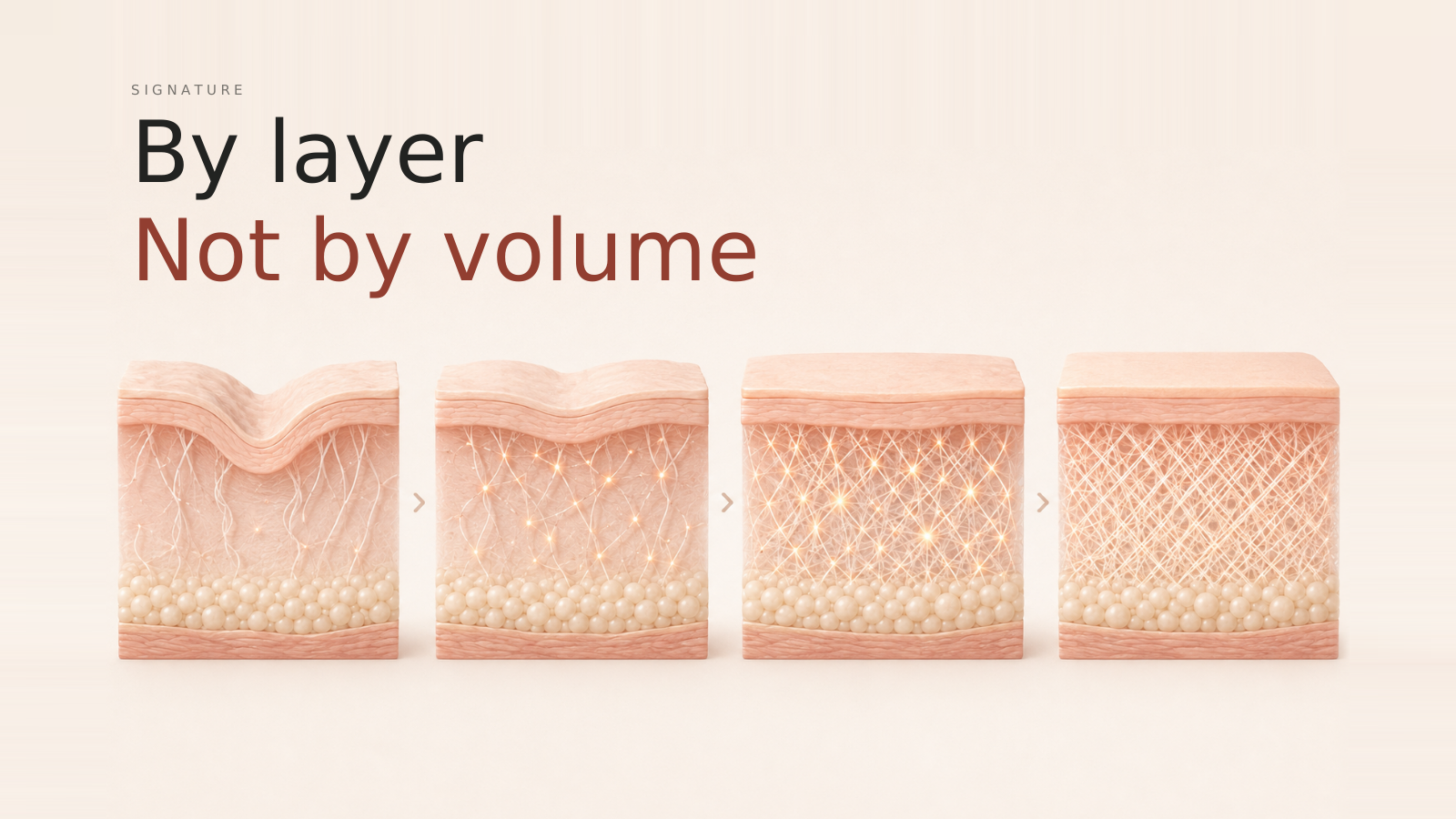
Collagen Bonding is not a filling treatment. It is a program that prompts a collagen response across three layers of the face, each in a different way — support at the deep layer, firmness in the middle, texture at the surface. Placing more of the same material and designing differently for each layer are not the same thing.
Some patients tell us that lifting treatments no longer last the way they used to.
This may not be a question of intensity. Energy lifting is good at tightening tissue, and it remains an important option for laxity. But what it provides is a pulling force.
If the structures holding the face from within have weakened, no amount of pulling from above will hold as long as you would like. What is needed then is a force that holds.
Collagen Bonding is the program that designs for the holding side.
Skin is not a single sheet. What it does changes with depth.
The deep layer — the membrane over the bone and the tissue around it. This is where the structures that anchor the face sit. As it loosens, the center of the face settles downward, and the area around the nasolabial folds, the cheeks and the jawline all blur together.
The middle layer — the mid dermis. Where firmness is made and maintained. Cheek descent, the area around the mouth, and the overall balance of a lift are decided here.
The surface layer — the upper dermis. Where texture, fine lines, and the way skin catches light are determined.
Here is where it goes one step further. Collagen is not one thing.
Type I collagen builds the structure of support and firmness in the deeper layers. Type III collagen is involved in texture and luminosity at the surface. In the middle layer, both are at work.
Which means what a layer needs depends on which layer you are addressing. One material cannot answer for all three. This is why Collagen Bonding is designed layer by layer.
The deep layer receives Radiesse (CaHA). The areas around the nasolabial region, in front of the ear, and along the structures that run from the cheekbone toward the jaw. Volume registers immediately, and a collagen response continues around those sites over time. The approach is not to rebuild the structures themselves, but to support the ground around them.
The middle layer receives Sculptra and Ollidia (PLLA). As the particles gradually break down, they prompt a collagen response over time. This is the layer that addresses cheek descent, the area around the mouth, and the overall balance of the lift. According to the manufacturer, the material remains in the body for up to 25 months — a figure describing the longevity of the material, not a guarantee of outcome.
The surface layer receives Ollidia 120 and Juvelook Skin. In the upper dermis, these prompt Type III collagen and work on texture, fine lines and the sense of hydration. This is the finish laid over a structure already in place.
This question is the heart of the program.
Increasing the volume of a single product loads one layer only. If the problem sits in the deep layer and only the surface is filled, texture improves while the face stays where it was. The reverse is equally true.
The question Collagen Bonding works on is not how much but where, and in what arrangement. Because each layer receives what suits it, structure and texture can be addressed together without excess volume anywhere.
Comparisons with filler come up often, but the two have different purposes. Filler restores a hollow immediately. Collagen Bonding, rather than filling, sets up the conditions for the body to build. Less a matter of which is better than of whether what you need now is immediate restoration or structure built over time.
Collagen Bonding is not the kind of program where the face changes on the day.
A collagen response happens gradually. Firmness tends to register first, then volume and the line of the face settle, and structural change reads later still. How quickly and how much varies with the condition of the skin.
Because of this, Collagen Bonding sits closer to care placed across a long span of time than to a single procedure. One visit designs all three layers, and later visits build on what is already there. For patients who cannot stay in Seoul for long, this characteristic actually works in their favor: the design is completed within a short visit, and the change proceeds after you have gone home.
We look at how lifting and other treatments fit around this in our piece on what follows a lifting treatment.
Where the weight falls across the three layers differs from person to person.
A doctor looks at where the descent began, how much of it is volume loss, and what condition the texture and thickness of the skin are in. Some faces need the deep layer addressed first; for others, the middle and surface layers are enough.
At DayBeau Gangnam, we settle the layer-by-layer design after that assessment. Because responses and duration differ from person to person, the design follows the diagnosis.
Structure rather than volume. Where rather than how much. What Collagen Bonding works on is not filling but design.
In most cases yes, but it depends on what was placed, where, and when. Filler restores a hollow directly; Collagen Bonding works on the conditions for the body to build. Your doctor will review your history before settling the layer-by-layer design.
The term is used loosely and usually describes filling with volume. Collagen Bonding is designed the other way around — each layer receives the material suited to it, so that structure and texture are addressed without adding volume where it is not needed.
They work on different things. Lifting applies a pulling force to tissue; Collagen Bonding builds the holding side from within. Because the two do not overlap, they are often designed together rather than chosen between. Your doctor will advise on how they are arranged.
If this sounds like your concern, these are the treatment pages to explore:
Written by the DayBeau Gangnam Medical Team · Medically reviewed by the DayBeau Gangnam Medical Team
Our consultants read the structure first, then the design.
Book a consultation→